













Minimally Invasive Hip Treatment for Labral Repair, Impingement Correction & Improved Mobility
Hip Arthroscopy is a minimally invasive orthopedic procedure used to examine and treat certain conditions affecting the hip joint. Through small incisions, the surgeon can address problems such as hip labral tears, femoroacetabular impingement, damaged cartilage, inflamed joint tissue, and loose fragments of bone or cartilage. Patients may consider Hip Arthroscopy when persistent hip pain, stiffness, catching, or reduced mobility has not improved sufficiently with nonsurgical treatment. The procedure is designed to preserve the natural hip joint while supporting improved movement, comfort, and daily function.
🔍 What Is Hip Arthroscopy?
Hip Arthroscopy is a surgical technique that allows an orthopedic surgeon to view the inside of the hip joint without making the larger incision required for traditional open surgery.
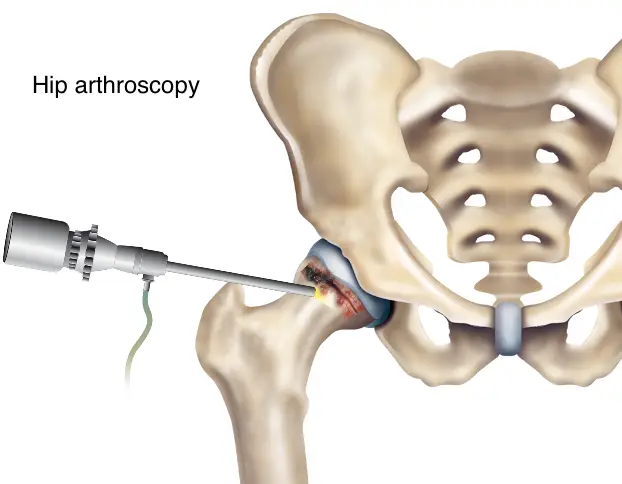
Small surgical instruments are inserted through additional incisions to examine and treat damaged structures. Depending on the diagnosis, the surgeon may repair the hip labrum, reshape excess bone, smooth damaged cartilage, remove inflamed tissue, or take out loose fragments within the joint. Damage to the labrum, cartilage, or surrounding soft tissues can contribute to pain, clicking, stiffness, and limitations during physical activity. Because Hip Arthroscopy uses small incisions and specialised instruments, it generally causes less disruption to surrounding soft tissues than open surgery. However, suitability and recovery depend on the patient’s diagnosis, the degree of joint damage, and the specific procedures performed during surgery.
🩺 Types of Hip Arthroscopy Procedures
- Hip Labral Repair – Uses sutures and small anchors to secure a torn labrum back to the edge of the hip socket.
- Femoroacetabular Impingement Correction – Reshapes excess bone around the femoral head or hip socket to reduce abnormal contact during movement.
- Hip Chondroplasty – Smooths unstable or damaged areas of articular cartilage to reduce irritation inside the joint.
- Loose Body Removal – Removes fragments of cartilage or bone that may cause locking, catching, or discomfort inside the hip.
🩺 Who Is a Good Candidate?
Hip Arthroscopy may be appropriate for selected patients with hip pain or mechanical symptoms caused by damage inside or around the joint. A detailed orthopedic assessment is required because not every hip condition can be treated effectively through arthroscopic surgery.
✔️ Individuals with persistent hip or groin pain
✔️ Patients diagnosed with a hip labral tear
✔️ Individuals with cam, pincer, or combined femoroacetabular impingement
✔️ Patients experiencing hip clicking, catching, locking, or restricted movement
✔️ Individuals with loose fragments of cartilage or bone inside the joint
✔️ Patients with selected cartilage injuries or inflamed synovial tissue
✔️ Individuals whose symptoms have not improved with rest, medication, injections, or physical therapy
📝 Consultation & Preparation
Consultation for Hip Arthroscopy includes a comprehensive review of the patient’s symptoms, mobility, imaging studies, previous treatments, and general health. The purpose is to confirm the source of the hip problem and determine whether arthroscopic treatment is likely to provide meaningful benefit.

✔️ Detailed review of hip pain, stiffness, clicking, locking, or instability
✔️ Physical examination of hip movement, strength, gait, and joint function
✔️ Review of previous injuries, operations, injections, and physical therapy
✔️ Assessment of X-rays, MRI scans, CT scans, or other available imaging
✔️ Evaluation of the labrum, cartilage, bone shape, tendons, and surrounding tissues
✔️ Review of current medications, supplements, allergies, and medical conditions
🩺 Recovery & Aftercare
Recovery after Hip Arthroscopy varies according to the condition treated and the extent of surgery performed. Patients undergoing a limited procedure may progress differently from those who receive labral repair, reconstruction, cartilage treatment, or extensive bone reshaping.
✔️ Temporary hip discomfort, swelling, stiffness, and fatigue may occur
✔️ Pain medication should be used only according to the medical team’s instructions
✔️ Surgical dressings and small incision sites must be kept clean and protected
✔️ Crutches or a walker may be required during the initial recovery period
✔️ Physical therapy helps restore movement, strength, balance, and walking mechanics

🌍 Why Choose Asan Medical Center for Hip Arthroscopy?
Choosing an experienced orthopedic centre is important because Hip Arthroscopy requires accurate diagnosis, specialised instruments, advanced imaging, and careful postoperative rehabilitation, all provided by Asan Medical Center’s multidisciplinary Department of Orthopedic Surgery. Its Hip and Trauma Surgery Section performs over 800 hip and pelvic procedures annually and offers coordinated international care, with Hip Arthroscopy as a listed specialty.

✔️ Dedicated Hip and Trauma Surgery Section
✔️ Orthopedic specialists with a clinical focus on hip disorders and Hip Arthroscopy
✔️ Experience managing complex hip and pelvic conditions
✔️ Access to minimally invasive and joint-preserving surgical techniques
✔️ Comprehensive orthopedic examination and advanced diagnostic imaging
✔️ Multidisciplinary coordination with radiology, rehabilitation medicine, and other specialties
✔️ Individual treatment planning based on joint structure and functional needs
✔️ Pre-operative and postoperative patient education
💬 Patient Reviews
⭐️⭐️⭐️⭐️⭐️
“My hip pain had gradually started affecting walking, exercise, and even sitting for extended periods. The medical team explained the arthroscopy process carefully and helped me understand the rehabilitation stages. As my recovery progressed, my movement became more comfortable and controlled.” – Michael R., USA
⭐️⭐️⭐️⭐️⭐️
“I had ongoing groin pain and clicking that did not improve enough with physical therapy. The evaluation was detailed, and the treatment plan focused on the specific damage inside my hip. I appreciated the clear communication and organised follow-up throughout recovery.” – Sophie L., France
⭐️⭐️⭐️⭐️⭐️
“The hospital team reviewed my scans and previous treatment records before discussing surgery. I felt reassured because the expected benefits and limitations were explained honestly. Rehabilitation required patience, but I gradually regained strength and confidence in my hip.” – Daniel K., Canada
⭐️⭐️⭐️⭐️⭐️
“I travelled to Seoul because I wanted a specialised assessment for a hip labral injury. The international coordination team helped organise the appointments and hospital process efficiently. My recovery plan was clear, structured, and adapted as my mobility improved.” – Amelia T., Australia
⭐️⭐️⭐️⭐️⭐️
“My hip used to catch during movement and caused discomfort during everyday activities. After the procedure and several weeks of guided rehabilitation, the joint began to feel smoother and more stable. The improvement was gradual, but it made a meaningful difference to my routine.” – Oliver W., UK
⭐️⭐️⭐️⭐️⭐️
“The medical team took time to explain how the shape of the hip joint was contributing to my symptoms. I valued their careful approach and the detailed instructions provided after surgery. Following the rehabilitation programme helped me rebuild mobility without rushing the process.” – Sofia M., Spain
⭐️⭐️⭐️⭐️⭐️
“I was nervous about undergoing treatment in another country, but the hospital coordination was professional and well organised. The staff guided me through the examinations, surgery preparation, and follow-up appointments. I felt supported during every stage of the hospital experience.” – Luca B., Italy
⭐️⭐️⭐️⭐️⭐️
“My goal was to return to regular activity without the persistent pain that had limited me for months. The surgeon discussed realistic expectations and emphasised that rehabilitation would be an important part of the outcome. My function continued to improve as I followed the therapy programme.” – Hannah S., Germany
⭐️⭐️⭐️⭐️⭐️
“The assessment was thorough and included a careful review of my symptoms and imaging. I appreciated that the team did not make unrealistic promises and explained why Hip Arthroscopy was being considered. The recovery required commitment, but the guidance made each stage easier to manage.” – Ethan J., New Zealand
⭐️⭐️⭐️⭐️⭐️
“I had difficulty with stairs, prolonged walking, and certain rotational movements before treatment. The postoperative instructions were detailed, and the rehabilitation team helped me progress safely. Over time, I noticed better movement and greater confidence during normal daily activities.” – Claire D., Switzerland