Kaiser Hospital Dia
Kaiser Hospital Dia. Advanced Digestive Health, Bariatric & Robotic Surgery in Brazil. The hospital combines…
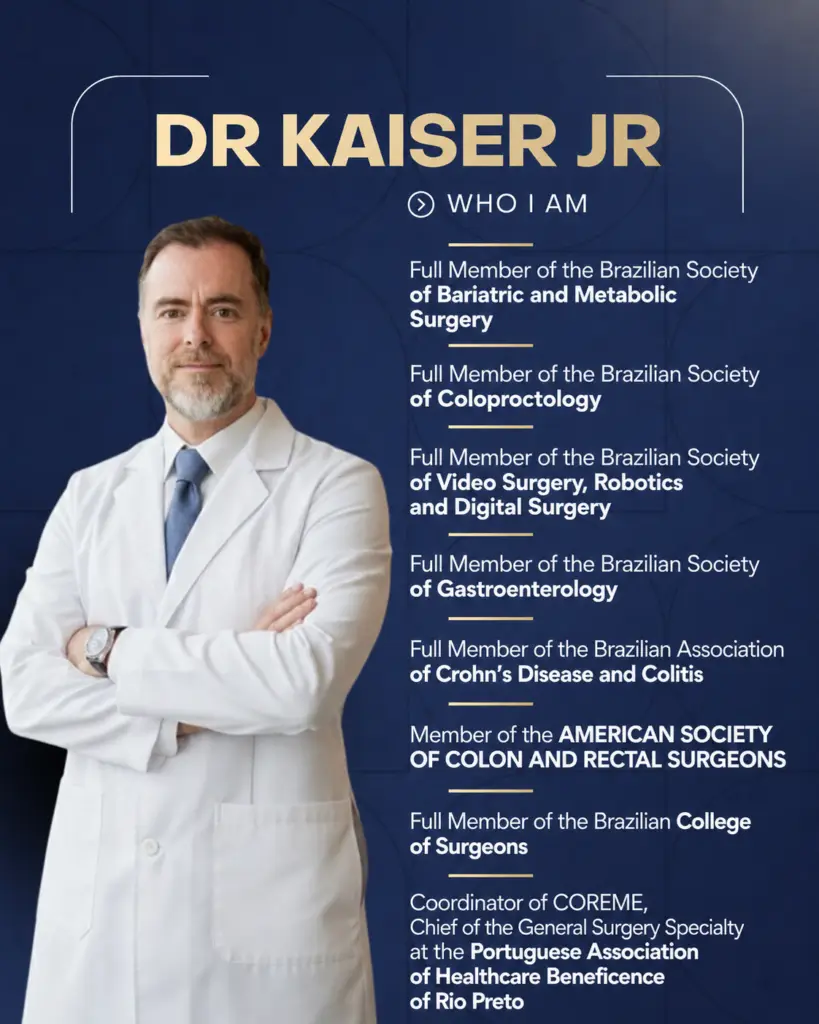
Prof. Dr. Roberto Luiz Kaiser Júnior is a Brazilian general surgeon and proctologist recognized for advanced minimally invasive surgery, international training, and leadership in the treatment of pilonidal cyst, bariatric surgery, hernias, anal fistula, and hidradenitis.
Prof. Dr. Roberto Luiz Kaiser Júnior is a strong choice for patients seeking advanced surgery in Brazil because his work combines more than 30 years of surgical experience, international fellowship training, academic leadership, minimally invasive techniques, and a recovery model designed to reduce unnecessary trauma to the body.
He is a General Surgeon and Proctologist, a pioneer of EPSIT in Brazil, the creator of the One Day Surgery concept, and an international reference in pilonidal cyst treatment. His approach is especially valuable for patients who want effective surgical care with less disruption to their work, travel plans, mobility, and daily life.
One of his greatest advantages is his international background. Dr. Kaiser Jr. trained as a Research Fellow in Colorectal Surgery at Cleveland Clinic Florida in 2001 and completed a Clinical Fellowship in Videolaparoscopic Digestive Surgery at Université Louis Pasteur in Strasbourg, France in 2002. This gives his surgical work a strong foundation shaped by advanced medical centers in the United States and Europe.
Dr. Kaiser Jr. has performed more than 300 EPSIT procedures, making him one of the most experienced names in minimally invasive pilonidal cyst treatment in Brazil and Latin America. EPSIT allows selected patients to treat pilonidal cyst without the large wounds, long dressing periods, and extended downtime commonly associated with conventional surgery.
His One Day Surgery model expands this same philosophy to selected cases of bariatric surgery, hernia repair, anal fistula, hidradenitis suppurativa, and other advanced surgical procedures. The goal is not simply early discharge, but a better-planned surgical journey with pre-operative optimization, minimally invasive techniques, ERAS recovery principles, pain-control strategies, structured follow-up, and faster return to daily activities whenever medically appropriate.
For international patients, Dr. Kaiser Jr. offers more than surgical experience. He offers a complete medical tourism structure supported by leading hospitals, premium logistics, bilingual assistance, translated medical documentation, extended follow-up, and coordinated care before, during, and after the trip. Through MyMediTour, patients can explore treatment with a doctor whose profile combines specialization, credibility, international training, and a modern recovery-focused surgical model.
Prof. Dr. Roberto Luiz Kaiser Júnior is a Brazilian General Surgeon and Proctologist with more than 30 years dedicated to surgery. His work focuses on restoring quality of life with minimal impact on the patient’s body, using advanced surgical techniques, minimally invasive procedures, and structured recovery protocols.
He is a pioneer of EPSIT in Brazil, creator of the One Day Surgery concept, and an international reference in pilonidal cyst treatment. His professional registration includes CRM 89.564 and RQE 52108 / 52109.
His surgical career is especially important for patients seeking treatment for conditions that can cause pain, discomfort, recurring infections, embarrassment, mobility limitations, or long recovery periods. Instead of focusing only on the procedure itself, Dr. Kaiser Jr. works with a complete surgical journey: diagnosis, treatment planning, hospital care, recovery, follow-up, and long-term quality of life.
Key highlights of his medical profile include:
His main areas of expertise include:
Dr. Kaiser Jr. also has a strong academic and leadership background. Since 2014, he has served as a professor in the Postgraduate Program in Health Sciences at FAMERP, helping train researchers, surgeons, and new medical specialists. He has participated in more than 30 examination boards at respected Brazilian institutions, including FAMERP, UNICAMP, UNESP, UFTM, UFPE, and USP.
In addition to his clinical work, he holds important leadership roles in Brazilian medicine, including Medical Director of Kaiser Clínica and Day Hospital, Chief of Specialty in General Surgery at the Portuguese Beneficent Association of São José do Rio Preto, Principal Investigator at the Clinical Research Center, Coordinator of the General Surgery Training Program at FAMERP / COREME, and President of the ROKA Institute for Education and Research.
For international patients, Dr. Kaiser Jr. offers a rare combination of specialized surgical expertise, international training, academic authority, hospital leadership, minimally invasive techniques, and a recovery-focused model designed to make surgery more efficient, organized, and patient-centered.


Dr. Kaiser Jr.’s credentials are one of the strongest parts of his profile. His medical journey combines Brazilian surgical training, international fellowships, academic research, specialist certifications, professional society memberships, and leadership roles in surgical education.
He earned his medical degree from the Federal University of Triângulo Mineiro — UFTM in 1996. From 1997 to 2000, he completed medical residency training in General Surgery and Proctology at Hospital de Base / FAMERP in São José do Rio Preto.
His international training includes two major fellowship experiences:
This international background is especially relevant for patients considering surgery abroad. Cleveland Clinic is widely recognized for advanced colorectal care, research, and surgical innovation, while Strasbourg has long been associated with minimally invasive surgery and laparoscopic education. This exposure helped shape Dr. Kaiser Jr.’s focus on precision, reduced surgical trauma, faster recovery, and modern treatment protocols.
In 2014, Dr. Kaiser Jr. earned his doctorate in Health Sciences from FAMERP — Medical School of São José do Rio Preto. His doctoral research focused on the influence of sphincter defects on biofeedback response in patients with fecal incontinence, reinforcing his deep expertise in colorectal function, pelvic floor disorders, and complex proctologic care.
Specialist titles held by Dr. Kaiser Jr. include:
He is also a member of major national and international medical societies, including:
His leadership history includes serving as President of the São Paulo Chapter of the Brazilian Society of Bariatric and Metabolic Surgery from 2017 to 2018 and Scientific Director of the same society during that period. He also participated in the board for Brazil’s first specialist title in Bariatric Surgery, contributing to an important milestone in the recognition of bariatric surgery as a specialty in Brazil.
One Day Surgery is the central concept behind Dr. Kaiser Jr.’s surgical model. The goal is to perform selected advanced procedures safely while reducing hospital stay, surgical trauma, pain, and recovery time.
This approach uses minimally invasive techniques, modern anesthesia, ERAS recovery protocols, careful pre-operative optimization, early mobilization, pain-control strategies, and structured follow-up. In eligible cases, patients may be discharged the same day or within 24 to 48 hours, depending on the procedure and clinical condition.
One Day Surgery does not mean rushing recovery. It means planning surgery with precision so the patient can recover in a more comfortable and controlled way. For medical tourism patients, this model is valuable because it creates a clearer timeline for consultation, surgery, local recovery, follow-up, and safe return home.
Dr. Kaiser Jr. is an international reference in pilonidal cyst treatment and a pioneer of EPSIT, or Endoscopic Pilonidal Sinus Treatment, in Brazil. EPSIT is a minimally invasive technique that treats the cyst from the inside using a small endoscopic instrument, avoiding the large external wounds associated with conventional open surgery.
A pilonidal cyst is an inflamed cavity that forms in the intergluteal cleft near the coccyx. It may cause pain, swelling, abscess formation, drainage, foul-smelling discharge, visible openings in the skin, fever during acute infection, and recurring episodes that affect work, social life, sports, intimacy, and self-confidence.
The EPSIT technique allows direct visualization of the cyst tract through a small fistuloscope, enabling the surgeon to identify branches, clean the cavity, remove hair and debris, and cauterize the internal lining under video guidance. For many patients, this means minimal scarring, less pain, no large open wound, and a much faster return to daily life compared with traditional surgery.
Conventional pilonidal cyst surgery often involves a larger incision, open wound care, daily dressings, more pain, visible scarring, and several weeks away from work, school, or physical activity. EPSIT was developed to change that experience.
With EPSIT, the procedure is typically performed through a very small endoscopic access point. The surgery usually lasts around 20 to 45 minutes, and selected patients may be discharged the same day. Many patients return to basic activities within 24 to 48 hours and gradually resume exercise over the following days or weeks, depending on healing and medical guidance.
Dr. Kaiser Jr.’s EPSIT program is especially persuasive for international patients because it addresses one of the biggest barriers to medical travel: recovery time. Patients who travel from the United States, Europe, Latin America, or other regions need a technique that supports faster mobility, predictable follow-up, and a safer return-home plan.
Dr. Kaiser Jr. also performs bariatric and metabolic surgery for patients living with obesity and obesity-related conditions such as type 2 diabetes, hypertension, sleep apnea, high cholesterol, fatty liver disease, and reduced quality of life.
Bariatric surgery is not simply an aesthetic procedure. It is a metabolic treatment used when obesity becomes a chronic, progressive disease that does not respond adequately to diet, exercise, or medication alone. Dr. Kaiser Jr.’s surgical options may include sleeve gastrectomy, Roux-en-Y gastric bypass, mini gastric bypass, revisional bariatric surgery, and selected advanced metabolic procedures.
His One Day Surgery philosophy is also applied to bariatric surgery through ERAS protocols, which support faster recovery, earlier mobilization, improved pain control, and reduced hospital stay in properly selected patients. Depending on the procedure and patient profile, discharge may occur within 24 to 48 hours, followed by nutritional guidance, medical follow-up, and teleconsultation support.
Hernias are among the most common surgical conditions worldwide, and Dr. Kaiser Jr. offers advanced treatment for abdominal wall hernias using modern minimally invasive techniques. His work includes inguinal, umbilical, and incisional hernia repair, with surgical planning based on the hernia type, size, location, symptoms, recurrence risk, and patient health profile.
Whenever appropriate, hernia repair may be performed using laparoscopic or robotic techniques. These approaches can allow smaller incisions, better visualization, more precise mesh placement, less postoperative pain, and faster return to normal activities compared with traditional open surgery in selected cases.
For international patients, hernia surgery in Brazil with Dr. Kaiser Jr. can be especially valuable when the plan includes careful imaging, hospital-based treatment, recovery monitoring, and a defined return-to-travel timeline. The goal is not only to repair the hernia, but to help the patient return to daily life safely and confidently.
Anal fistula is a complex condition that can cause pain, drainage, recurring infection, discomfort, embarrassment, and major impact on quality of life. Traditional treatment can be challenging because the fistula tract may pass near or through the sphincter muscles, making continence preservation a major priority.
Dr. Kaiser Jr. works with advanced coloproctology techniques designed to treat anal fistula while protecting sphincter function whenever possible. Depending on the case, treatment may involve fistulotomy for simple fistulas, VAAFT, LIFT, FiLaC, fibrin glue, advancement flap, or other individualized approaches.
The key advantage is not one single technique. It is the ability to correctly diagnose the fistula, map the tract, understand the relationship with the sphincter, and choose the safest and most effective option for that specific patient. For people who have already undergone failed fistula treatment, this level of specialization is especially important.
Hidradenitis suppurativa is a chronic inflammatory disease that causes painful nodules, abscesses, draining tunnels, scarring, and recurring infections in areas such as the armpits, groin, perianal region, and under the breasts. Many patients spend years receiving incorrect diagnoses such as boils, folliculitis, ingrown hairs, cysts, or recurrent abscesses.
Dr. Kaiser Jr. provides specialized surgical assessment and individualized treatment planning for hidradenitis. His approach may involve proper staging, evaluation of affected areas, surgical removal of diseased tissue, functional preservation, post-operative care, and coordination with other specialties when needed.
This is a condition where experience matters because surgery must be planned carefully. The goal is to remove diseased tissue while preserving function, reducing recurrence risk, supporting healing, and improving the patient’s daily comfort and quality of life.
São Paulo is one of the strongest medical tourism destinations in Latin America and one of the most important cities in the world for healthcare, business, innovation, gastronomy, and international connectivity. For patients traveling to Brazil for surgery, São Paulo offers a sophisticated urban environment with major hospitals, private clinics, diagnostic centers, premium hotels, and strong airport access.
The city is home to some of Brazil’s most respected hospitals and healthcare institutions, including internationally recognized private hospital networks. For patients choosing Dr. Kaiser Jr., São Paulo offers the advantage of combining advanced surgical care with the convenience of a major global city.
São Paulo is also practical for patients who value privacy, comfort, and efficient logistics. The city offers executive transfers, premium accommodations, high-end restaurants, international shopping, cultural attractions, and neighborhoods designed for business and medical travelers. This makes the surgical journey easier to organize, especially for patients coming from the United States, Europe, Latin America, or the Middle East.
Dr. Kaiser Jr.’s medical tourism model includes a premium travel and hospitality structure through his official partnership with ByDest, a Destinations Group brand and Virtuoso member. This partnership brings high-end travel curation into the surgical journey, with attention to hotel selection, transfers, logistics, and patient comfort.
Patients may have access to premium accommodations in São Paulo, including hotels in strategic neighborhoods such as Jardins, Itaim Bibi, Jardim Paulista, and Panamby. These areas offer comfort, privacy, dining options, and practical access to major hospitals such as Sírio-Libanês, Albert Einstein, and São Luiz, depending on the patient’s surgical plan.
Executive mobility may include private airport, hotel, and hospital transfers, with options such as executive sedans, premium SUVs, minivans for companions, and armored vehicles when requested. For international patients, this level of coordination reduces stress and helps the patient focus on treatment, recovery, and follow-up instead of logistics.
Dr. Kaiser Jr.’s care model is built around an extended surgical journey. Patients begin with assessment and surgical planning, proceed to treatment at a leading hospital, recover locally with medical monitoring, and continue follow-up after returning home.
The recovery pathway may include teleconsultation before travel, pre-operative testing, hospital surgery, discharge within the planned One Day Surgery timeline when appropriate, local recovery for several days, dressings or daily visits depending on the procedure, and remote follow-up for 30 to 90 days or longer depending on the treatment package.
For international patients, translated medical documentation is a major advantage. Surgical reports, exams, prescriptions, and clinical summaries can help the patient continue care with a physician in their home country. This supports continuity of care and makes the return-home process more organized and safer.
International patients traveling to Brazil for surgery should confirm passport, visa, and entry requirements before booking flights. Requirements vary by nationality, passport type, travel purpose, and length of stay. U.S., Canadian, and Australian citizens are currently subject to Brazil visitor visa requirements for tourism and business travel, and eligible travelers may apply through Brazil’s e-Visa process.
Patients should travel with a valid passport, visa or e-Visa when required, appointment confirmations, hotel details, return flight information, medication list, allergy information, previous medical records, surgical history, imaging exams, lab results, and any documentation requested during the pre-operative evaluation.
For surgical travel, patients should plan the trip around the medical timeline rather than the cheapest flight dates. This means allowing enough time for arrival, in-person evaluation, exams if needed, surgery, early recovery, follow-up, and medical clearance before returning home. For EPSIT, selected patients may have a shorter recovery timeline; for bariatric surgery, hernia repair, hidradenitis, or anal fistula procedures, the required stay depends on the case and should be confirmed during planning.
Discover more medical providers across Brazil.

Kaiser Hospital Dia. Advanced Digestive Health, Bariatric & Robotic Surgery in Brazil. The hospital combines…